
Why Texting Causes Fights in Relationships (2026 Research)

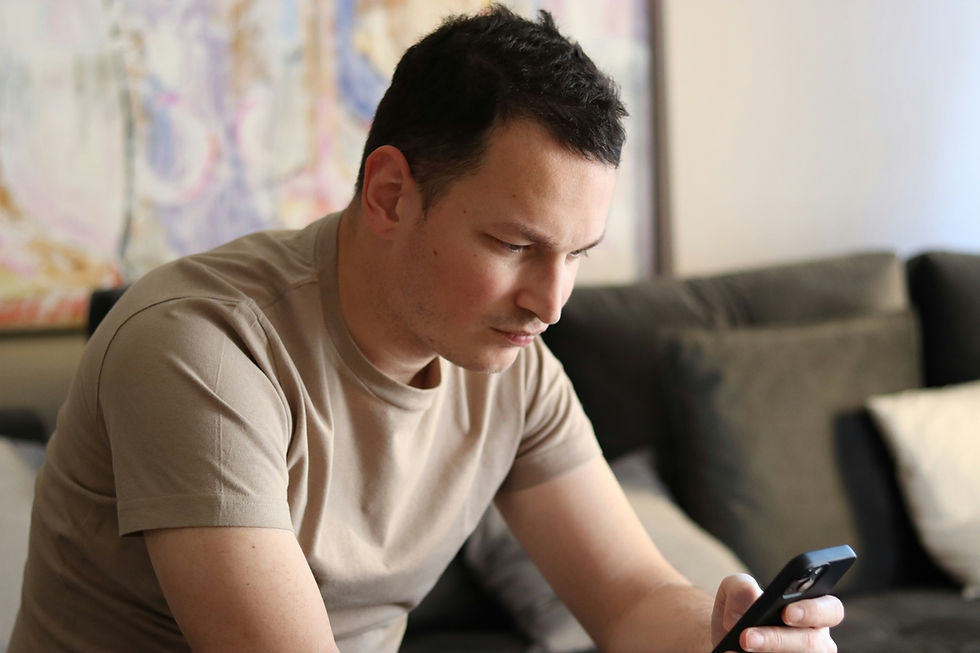
Somewhere right now, a perfectly good relationship is being dismantled by a gray bubble that says "K." Not by infidelity. Not by money. By a two-letter text, a three-dot pause that lasted too long, and a punctuation mark that landed like a slammed door.
If that sounds dramatic, the research is more dramatic.
Scientists have now studied texting couples by the tens of thousands, and the verdict is in: the phone in your hand is one of the most reliable conflict generators ever invented— and almost nobody is fighting about what they think they're fighting about.
Here's what the newest studies actually found, why your brain is biologically terrible at texting, and the one skill that separates couples who thrive from couples who spiral: matching the message to the medium.
Your Text Arrived Naked
Face-to-face, your words travel with an entourage. Tone of voice, a raised eyebrow, a softening smile, a hand on a shoulder — communication researchers call these paralinguistic cues, and they do enormous work in telling your partner what you mean, especially when your words are ambiguous.
A text message shows up with none of that. It's your sentence stripped down and shoved through a keyhole. A sunset photographed in black and white. A symphony played on a kazoo. The notes are technically there. The meaning is not.
And here's the twist that should genuinely unsettle you:
you have no idea this is happening.
In a now-legendary series of experiments, psychologists Justin Kruger and Nicholas Epley had people send sarcastic, serious, and funny messages by email, then predict how well recipients would understand them. Senders were supremely confident. In one experiment, 97% of senders believed their tone would be decoded correctly — but only 84% of messages actually were. Even more damning: the recipients were just as overconfident about their ability to read tone as senders were about conveying it. Both sides walked away certain they'd communicated, while a meaningful slice of every exchange quietly curdled into misunderstanding.
The researchers named the culprit egocentrism: when you write a text, you hear it in your head with your intended tone — warm, joking, neutral. You cannot un-hear it. Your partner, meanwhile, reads it in whatever tone their mood, their history, and their anxiety supply. You sent a shrug. They received a shove.
Now do that 100 times a day, about logistics, feelings, in-laws, and who forgot the dry cleaning.
When Couples Fight by Text, the Damage Is Measurable
This isn't just theory. When researchers had couples hash out real conflict topics face-to-face, by phone, or by instant message, the couples who argued through typed messages showed greater drops in mood after the discussion. Same disagreement, worse hangover — purely because of the channel it traveled through.
Why? Three mechanisms show up again and again in the literature:
First, negativity fills the silence. Research on workplace messages found that text-based communication has a documented negativity bias — ambiguous or even neutral messages get read as colder and more hostile than intended, and playful messages routinely land as criticism. In one analysis of real-life texted miscommunications, a large share came from one partner completely missing the other's humorous or sarcastic tone and interpreting the message as more negative than intended. Your partner isn't reading your texts. They're reading their fears, with your words as the script.
Second, the pause becomes the message. In person, silence has a face attached. Over text, a delayed reply is a Rorschach test. Anxiously attached partners — people who fear abandonment — are especially prone to filling that gap with catastrophe. Three hours of no response isn't "busy at work." It's evidence.
Third, texting removes the brakes. Psychologists studying online communication describe a disinhibition effect: without a human face in front of us, we type things we would never say. Your thumbs have less conscience than your mouth. Every couples coach has seen the transcript: two people who love each other, escalating in writing, saying scorched-earth things at a speed and severity no kitchen argument would ever reach — with the added bonus that the whole fight is now saved, searchable, and re-readable at 2 a.m.
The Phone Doesn't Even Have to Buzz to Hurt You
The newest wave of research reveals something stranger: your phone damages your relationship even when you're not texting.
Scientists call it phubbing — phone snubbing — the act of ignoring your partner in favor of your screen. A 2025 meta-analysis pooling 52 studies and 19,698 people found that partner phubbing significantly erodes relationship satisfaction, intimacy, emotional closeness, and responsiveness, while directly fueling conflict and jealousy.
A 2025 University of Southampton diary study tracked 196 adults for ten days and found that on days people felt phubbed, they reported worse mood, lower self-esteem, more resentment — and they retaliated by picking up their own phones, often to seek validation from other people. One researcher described these moments as micro-ruptures that accumulate into the felt sense that you are less valuable than a rectangle of glass. Another line of research calls phubbing what it really is: micro-ostracism.
Being benched at your own dinner table.
And it's not rare.
A 2025 study that used objective phone-tracking data — not self-reports — found people were on their phones during 27% of the time spent with their partner, and 86% used their phone every single day while with their partner. Pew data shows women are twice as likely as men to say they're often bothered by a partner's phone use.
Read those numbers again. Over a quarter of your togetherness, outsourced to a device. That's not a habit. That's a third party in the relationship.
Texting Isn't the Villain. Mismatched Texting Is.
Here's where the research gets genuinely surprising — and where most "put down your phone" articles get it wrong.
Texting, it turns out, is not universally bad for couples. It's conditionally bad. The same behavior that corrodes one relationship strengthens another:
Long-distance couples flourish on text. A study published in a peer-reviewed journal found that more frequent and responsive texting predicted significantly higher relationship satisfaction for long-distance couples — a benefit that didn't appear for couples living in the same city. For partners separated by miles, the steady drip of messages functions like a pulse: proof of life, proof of love.
Avoidant partners sometimes open up more in writing. Research on attachment styles found that texting was linked to more positive relationship outcomes for highly avoidant individuals — people who feel flooded in intense face-to-face emotional conversations. For them, the screen's distance isn't a bug. It's a ramp.
Matching matters more than volume. One of the most elegant findings in this literature: relationship satisfaction isn't predicted by how much couples text, but by how similar their texting styles are. Couples who mirror each other — in initiation, in affection, even in emoji use — report higher satisfaction. It's not the number of messages. It's whether you're dancing to the same song.
Even the conflict research has nuance. A 2026 systematic review of technology-mediated conflict in couples found that dissatisfied partners were sometimes more likely to attempt repair over text than in person — the medium gave them a safer on-ramp back to each other.
So the real headline isn't "texting is toxic." It's this: there is no best medium.
There is only the best medium for this couple, this conversation, this moment. Getting that match right is a relationship skill — arguably the modern relationship skill.
The Medium Match: A Rule of Thumb for Your Thumbs
Think of communication channels like tools in a kitchen. A whisk is not worse than a knife. But try slicing a tomato with a whisk and you'll conclude the tomato is the problem.
Communication scholars have a name for this: media richness. Every channel carries a different amount of human signal. Face-to-face carries the most — words, tone, face, body, touch, instant repair. Video call carries most of it. Phone call keeps the voice but loses the face. Voice memo keeps warmth but loses the back-and-forth. Text keeps only the words — fast, convenient, and emotionally starving.
The Medium Match principle is simple: the more emotion a conversation carries, the richer the channel it needs.
Logistics, grocery lists, "thinking of you," a meme that made you laugh, a "landed safe" — texting is magnificent here, and research confirms these small affectionate pings genuinely build connection. But conflict, criticism, big feelings, big decisions, apologies that matter? Those conversations need a voice at minimum and a face when possible.
The famous couples-research finding that healthy relationships run on roughly five positive interactions for every negative one extends to your message thread — and a negative message hits harder in text precisely because there's no face to soften it.
And this is where your couple-specific fit comes in. The right medium for you two depends on your distance, your schedules, your attachment styles, and your histories. An anxious partner may need the certainty of a voice; an avoidant partner may need the runway of writing before a face-to-face talk. The couples who thrive aren't the ones who text least. They're the ones who have actually talked about how they talk — out loud, on purpose — and built their own rules.
Try This Tonight: The Channel Conversation
Sit down with your partner — in person, ideally, for obvious reasons by now — and design your communication agreement. Decide together which conversations are "text-safe" and which are "voice-or-better." Agree on a flare phrase either of you can send when a thread starts heating up — something like "This is turning into a real conversation. Call me?" — that ends the typed fight without ending the discussion. Talk honestly about response-time expectations, because half of texting anxiety is two people carrying two different invisible rulebooks. And name your phone-free zones: the dinner table, the bedroom, the first ten minutes after reuniting. The research on phubbing suggests those small protected windows do outsized work.
None of this requires willpower. It requires one conversation — held in a rich enough channel to actually land.
The Bottom Line
The evidence from tens of thousands of studied couples points one direction: texting doesn't just carry conflict, it manufactures it — stripping tone, inviting worst-case interpretation, removing inhibition, and stealing attention even while idle. And yet the same research shows texting knitting long-distance lovers together and giving avoidant hearts a doorway to intimacy.
The phone was never the villain, and it was never the hero. It's a kazoo. Wonderful for a jingle. Catastrophic for a symphony.
Your relationship deserves to be scored correctly. If you and your partner keep having the same fight in the same gray bubbles, the problem may not be your love, your intentions, or even your communication skills — it may simply be your channel. That's fixable. Often in a single conversation.
And if you'd like help having that conversation, that's exactly what coaching is for.
More blogs you might enjoy:
Sources & further reading:
Kruger, J., Epley, N., Parker, J., & Ng, Z. (2005). Egocentrism over e-mail: Can we communicate as well as we think? Journal of Personality and Social Psychology.
Ni, Ahrari, Zaremohzzabieh, et al. (2025). A meta-analytic study of partner phubbing and its antecedents and consequences. Frontiers in Psychology. (52 studies, N = 19,698)
Carnelley, K., Hart, C., et al. (2025). Attachment, Perceived Partner Phubbing, and Retaliation: A Daily Diary Study. Journal of Personality.
Denes, A., et al. (2025). Phone or affection? Examining dyadic perceptions of partner phubbing, affection deprivation, and relationship satisfaction. Journal of Social and Personal Relationships.
Daspe, M-È., et al. (2026). A systematic review of technology-mediated conflict management in couples. Journal of Social and Personal Relationships.
Text messaging and relationship satisfaction in long-distance relationships (2021). PMC / peer-reviewed.
Partner similarity in texting and relationship satisfaction. Computers in Human Behavior.
Burge & Tatar (2009). Conflict discussions across face-to-face, phone, and instant messaging.
Human Behavior and Emerging Technologies (2025). Objective smartphone tracking around partners; Pew Research Center data on partner phone use.



1 Comment